Notes of a Public Park
Notes of a Public Park
On Art, Community and the Production of Space
When Michelangelo Pistoletto's Venere degli Stracci was installed in the middle of Piazza Municipio in Naples during the summer of 2023, the work quickly sparked conversation in the art world and, for perhaps the first time in centuries, Venus was discussed less for what she represented symbolically than for the place she had suddenly come to occupy. A classical female nude facing a mountain of discarded clothing had become part of one of the city's biggest public squares, where she was photographed, celebrated, criticized and subsequently made fun of. Newspapers ran stories about it, politicians weighed in, and social media filled with opinions about its relevance, its aesthetics and whether it belonged there at all. Neapolitans just passing by, wondering nothing more than: “Ma che cazzo ci fa 'sta roba qua?”
The installation was destroyed by fire a few weeks after. The sculpture disappeared, the discussion became louder. For a quick moment, contemporary art no longer belonged to museums, galleries or those already familiar with its language - it became part of everyday conversation, claimed by the city itself, belonged to commuters crossing the square every morning, to passers-by who had never intended to encounter an artwork and to people who suddenly found themselves debating contemporary art over coffee, at the bus stop or on the way home.
For decades, the art world has been debating how contemporary art can become more accessible. Museums have expanded their educational and public programmes, lowered their ticket prices, and redesigned their institutional structures in the search for new ways of engaging with a changing audience. While these remain necessary conversations, they often start from the same assumption: people should “come to art”, forgetting what happens when art decides to come to people instead, in places that already carry their own histories and identities. Art does not belong only to those who understand it - if art functions only for an elite, it fails its main purpose. Long before museums and biennials, art belonged to rituals, marketplaces, churches, streets and public squares. Art doesn't lose its value when it leaves the museum - maybe it even remembers why it existed in the first place.
When displayed in a public space, its narrative changes because it suddenly shares the same space with children learning to ride bicycles, elderly people sitting on a bench, football matches, barking dogs, and afternoon conversations that have nothing to do with exhibitions. An artwork displayed in such a space might lose some of the concentrated attention promised by the White Cube-concept but gains something much less predictable: fragments of conversation, contradiction, coincidence. A sculpture competes with birdsong, an installation becomes part of a yoga session in the park. What museums often describe as 'distraction' suddenly becomes the precise condition that allows art to participate in people's lives.
The city of Rome, understands this balance surprisingly well. In a city defined by its multiple layers of history, Villa de Sanctis park is a rare place where those layers remain visible and tangible. Hidden between Via Casilina and Via dei Gordiani, the park carries nearly two thousand years of Roman history beneath its pathways. Once part of the imperial estate of Ad Duas Lauros, and later the burial ground of the imperial cavalry guards (the equites singulares), after Emperor Constantine commissioned the Basilica of Saint Marcellinus and Saint Peter, and the Mausoleum of Helena, the park became one of early Christianity's most significant pilgrimage sites. Over the centuries, the sacred ground gave way to agricultural land, private property to the De Sanctis family, and later became an abandoned fragment of the city waiting to be reclaimed. Like Rome itself, Villa de Sanctis has spent centuries changing its identity and every generation has added its own layer behind.
Its more recent history follows a surprisingly similar rhythm. Although the De Sanctis family donated the estate to the Municipality of Rome in 1942, the area remained inaccessible to the general public for decades. Scrap yards, warehouses, allotment gardens, and squatters slowly replaced the idea of public space. It took years of persistent work by neighbourhood committees and local residents before Villa de Sanctis gradually became a park. The restoration of the historic villa, the creation of the Casa della Cultura in 1962, and the landscape we know today grew out of collective determination. Public space was reclaimed by the community itself.
Today, early mornings in the park belong to runners and Senior strollers. Afternoons fill its green grounds with families, children, and teenagers. In the evening, different communities gather beneath the trees to cook, share meals, play cards, make music, or simply spend some time together. The park changes because the people in it change.
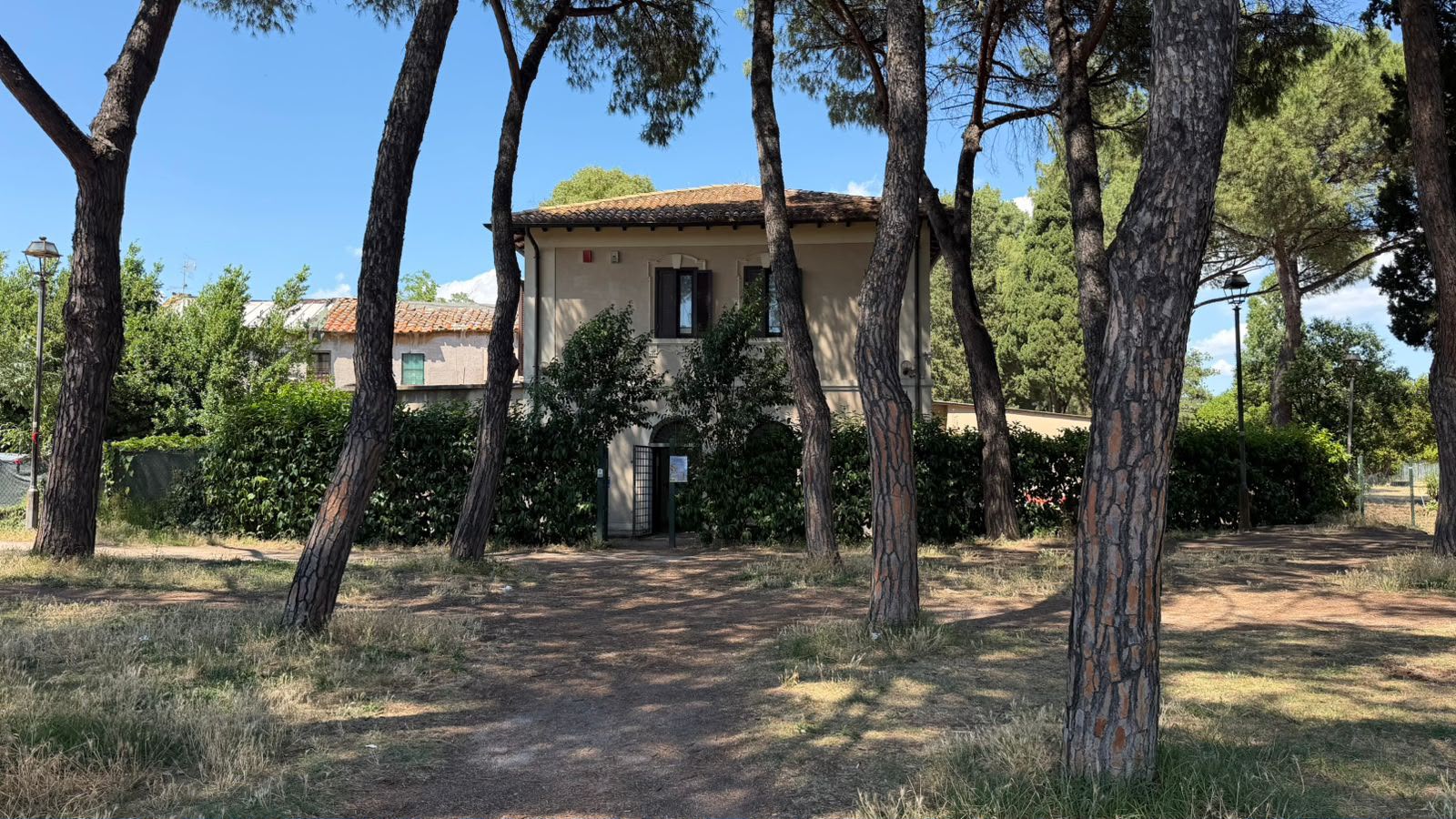
Since its inception, the "Casa della Cultura e dello Sport Silvio di Francia", has been the epicenter of community events and debates. Serving as a library, cultural centre, neighbourhood meeting place, and public living room, the house extends naturally into the life of the park, with a design that allows a fluid flow of visitors between the building and the surrounding green areas hardly noticing where one space ends and the other begins.
Simbiosi Ambientale, Art Festival and Exhibition taking place in Villa de Sanctis in mid-september 2026, is a new chapter in a story that has already been written for centuries. Villa de Sanctis has been producing culture long before an exhibition was imagined here, it lives beneath the ground, inside archaeological layers, around shared meals, football matches, neighbourhood routines and conversations repeated every evening on the same benches. Simbiosi simply joins this ongoing exchange, in which young artists will change the park for a few days. However, the park, might even change the artworks just as much.
Perhaps this also asks something of curating today. Before selecting artists, writing exhibition texts or designing installations, we first need to understand the places we work with. Every neighbourhood has developed for a reason, and those traces inevitably become part of each one of the artworks displayed there, whether we acknowledge them or not. The task of art curating in a public space is, therefore, not merely to fill an empty space with art, but to recognize that the space was never really empty to begin with.
By Stefanie Lang
On Art, Community and the Production of Space
When Michelangelo Pistoletto's Venere degli Stracci was installed in the middle of Piazza Municipio in Naples during the summer of 2023, the work quickly sparked conversation in the art world and, for perhaps the first time in centuries, Venus was discussed less for what she represented symbolically than for the place she had suddenly come to occupy. A classical female nude facing a mountain of discarded clothing had become part of one of the city's biggest public squares, where she was photographed, celebrated, criticized and subsequently made fun of. Newspapers ran stories about it, politicians weighed in, and social media filled with opinions about its relevance, its aesthetics and whether it belonged there at all. Neapolitans just passing by, wondering nothing more than: “Ma che cazzo ci fa 'sta roba qua?”
The installation was destroyed by fire a few weeks after. The sculpture disappeared, the discussion became louder. For a quick moment, contemporary art no longer belonged to museums, galleries or those already familiar with its language - it became part of everyday conversation, claimed by the city itself, belonged to commuters crossing the square every morning, to passers-by who had never intended to encounter an artwork and to people who suddenly found themselves debating contemporary art over coffee, at the bus stop or on the way home.
For decades, the art world has been debating how contemporary art can become more accessible. Museums have expanded their educational and public programmes, lowered their ticket prices, and redesigned their institutional structures in the search for new ways of engaging with a changing audience. While these remain necessary conversations, they often start from the same assumption: people should “come to art”, forgetting what happens when art decides to come to people instead, in places that already carry their own histories and identities. Art does not belong only to those who understand it - if art functions only for an elite, it fails its main purpose. Long before museums and biennials, art belonged to rituals, marketplaces, churches, streets and public squares. Art doesn't lose its value when it leaves the museum - maybe it even remembers why it existed in the first place.
When displayed in a public space, its narrative changes because it suddenly shares the same space with children learning to ride bicycles, elderly people sitting on a bench, football matches, barking dogs, and afternoon conversations that have nothing to do with exhibitions. An artwork displayed in such a space might lose some of the concentrated attention promised by the White Cube-concept but gains something much less predictable: fragments of conversation, contradiction, coincidence. A sculpture competes with birdsong, an installation becomes part of a yoga session in the park. What museums often describe as 'distraction' suddenly becomes the precise condition that allows art to participate in people's lives.
The city of Rome, understands this balance surprisingly well. In a city defined by its multiple layers of history, Villa de Sanctis park is a rare place where those layers remain visible and tangible. Hidden between Via Casilina and Via dei Gordiani, the park carries nearly two thousand years of Roman history beneath its pathways. Once part of the imperial estate of Ad Duas Lauros, and later the burial ground of the imperial cavalry guards (the equites singulares), after Emperor Constantine commissioned the Basilica of Saint Marcellinus and Saint Peter, and the Mausoleum of Helena, the park became one of early Christianity's most significant pilgrimage sites. Over the centuries, the sacred ground gave way to agricultural land, private property to the De Sanctis family, and later became an abandoned fragment of the city waiting to be reclaimed. Like Rome itself, Villa de Sanctis has spent centuries changing its identity and every generation has added its own layer behind.
Its more recent history follows a surprisingly similar rhythm. Although the De Sanctis family donated the estate to the Municipality of Rome in 1942, the area remained inaccessible to the general public for decades. Scrap yards, warehouses, allotment gardens, and squatters slowly replaced the idea of public space. It took years of persistent work by neighbourhood committees and local residents before Villa de Sanctis gradually became a park. The restoration of the historic villa, the creation of the Casa della Cultura in 1962, and the landscape we know today grew out of collective determination. Public space was reclaimed by the community itself.
Today, early mornings in the park belong to runners and Senior strollers. Afternoons fill its green grounds with families, children, and teenagers. In the evening, different communities gather beneath the trees to cook, share meals, play cards, make music, or simply spend some time together. The park changes because the people in it change.
Since its inception, the "Casa della Cultura e dello Sport Silvio di Francia", has been the epicenter of community events and debates. Serving as a library, cultural centre, neighbourhood meeting place, and public living room, the house extends naturally into the life of the park, with a design that allows a fluid flow of visitors between the building and the surrounding green areas hardly noticing where one space ends and the other begins.
Simbiosi Ambientale, Art Festival and Exhibition taking place in Villa de Sanctis in mid-september 2026, is a new chapter in a story that has already been written for centuries. Villa de Sanctis has been producing culture long before an exhibition was imagined here, it lives beneath the ground, inside archaeological layers, around shared meals, football matches, neighbourhood routines and conversations repeated every evening on the same benches. Simbiosi simply joins this ongoing exchange, in which young artists will change the park for a few days. However, the park, might even change the artworks just as much.
Perhaps this also asks something of curating today. Before selecting artists, writing exhibition texts or designing installations, we first need to understand the places we work with. Every neighbourhood has developed for a reason, and those traces inevitably become part of each one of the artworks displayed there, whether we acknowledge them or not. The task of art curating in a public space is, therefore, not merely to fill an empty space with art, but to recognize that the space was never really empty to begin with.
By Stefanie Lang