Art & Combatting Convenience
Art & Combatting Convenience
How art can reconnect us to the land & lost tradition
For centuries, humans tended to the land, rooting and uprooting, reaping and sowing. With sun on their skin and soil beneath their fingernails, farmers turned the Earth into a regenerative food source for their communities. Barren lands became fruitful territory. Hungry stomachs were fed by hands never idle. Today, most of us enjoy our food without ever seeing the soil that made it possible. Fields and shovels have been replaced with fridges and shopping baskets. Modern society strives to prioritise convenience, but what do we sacrifice by making things too easy for ourselves?
Farming traditions and processes often involved a connection to the land through an understanding of what the earth had to offer when we worked with it, not against it. Industrialisation and urbanisation gradually shifted many people from fields to factories, and eventually to offices. Perhaps it is not just the labour lost with this shift, but also the relationship that came with it. Along with this change came the digital era, which has brought with it a relentless surge of stimuli that allows us to entertain ourselves without ever leaving the comfort of our homes. In the past, boredom was often tackled with activities such as knitting, gardening or simply being outdoors. What may have been a stimulating pastime to our ancestors can now require a more intentional type of focus, since we rarely allow ourselves to become “bored”. Instead of repetitive or physical activities, we tend to choose more convenient methods of entertainment, entering a digital world detached from the natural one.
Convenience has removed many of the uncomfortable, time-consuming parts of life. In doing so, perhaps we have lost the ability to be patient, to observe, to connect. If we could find ways to reconnect with tradition and with the land, we could rediscover these parts of ourselves without pretending we need to return to pre-industrial life. What if we could reimagine traditional processes and encourage ourselves to ponder our connection to the natural world? This is where art comes in; particularly, environmental art, both in the process of making it and through observing it. For the artist, the value lies in the process of exploring the outdoors, gathering natural materials and then intertwining, adapting and working with them. In this case, environmental art provides an opportunity to connect with something more primal in us that desires to work hands-on with natural materials. Through this act of creation, we can reimagine the meticulous processes present in traditional work before the convenience of modern life, while reconnecting physically and spiritually with the land. For the viewer, environmental art asks us to slow down and look again. It brings our awareness back to our roots, encouraging us to observe, inspect and then reflect on our own relationship to the material. We can find a moment with the work to pause and connect to the original source material: the land.
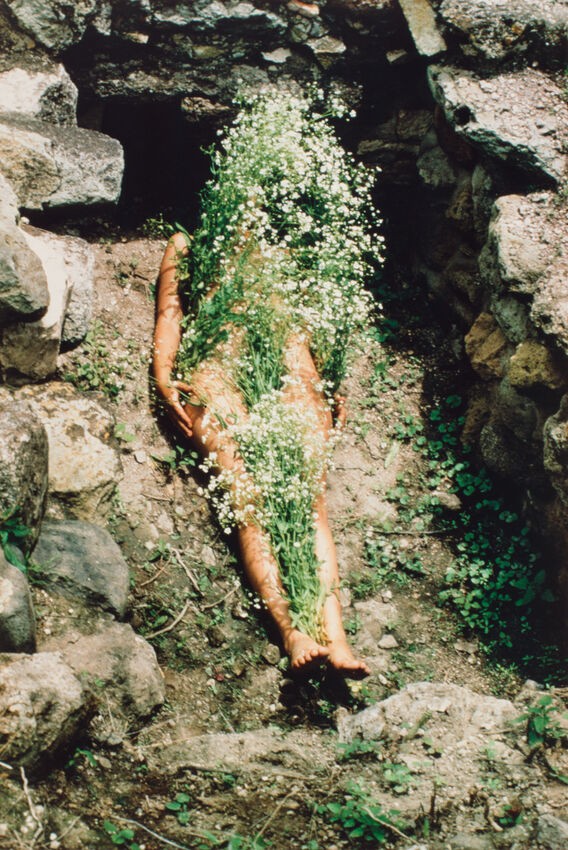
The land is as much about memory, identity and belonging as it is about plants and animals. Few artists demonstrate this more powerfully than Ana Mendieta. Exiled from Cuba at the young age of twelve, Mendieta struggled with feelings of alienation and detachment from the land throughout her life. In a documentary released after her death, she explains “I was attracted to nature because I didn’t have a land, a motherland.” (Mendieta, 1987). To deal with this sense of displacement, she completed a series of sculptural pieces entitled the Silueta Series (Silhouette Series) from 1973-1980. This series depicted outlines of the human body sometimes created with the silhouette of her own body, and at other times with natural materials and elements like mud, fire, water, flowers and blood. Many of Mendieta’s pieces were created in the form of private ritual, where she could access ancestral wisdom and reconnect to her roots. In Image from Yagul, 1973 (Fig.1), Mendieta places herself directly into the ruins of a Zapotec tomb, her nude body enveloped in white flowers. There is a reference here to human burial, one of our oldest rituals. Mendieta was interested in how the human body returns to the earth after death. From this death comes new life, like sprouting flowers, and so the cycle of life continues. This cycle is one we cannot deny we are a part of, reminding Mendieta and in turn us as viewers, that no matter how lost we may feel, we always have a home in Mother Earth. “My art is the way I re-establish the bonds that unite me to the universe. It is a return to the maternal source.” (Mendieta, 1981).
While our contemporary experiences of detachment stem from different circumstances, there is a lot to learn from Mendieta’s ability to find her way back to the land. Mendieta did not lose her connection to the land and her ancestral traditions because of convenience, but rather through displacement. Her work therefore reveals another aspect of our relationship with the earth: what we are at risk of losing is not simply the knowledge of how to work the land, but also our sense of belonging to it. The act of returning to it, physically and creatively, can help us recover something that modern life can so easily make us forget. Whatever the cause of our separation, art can offer a way back. A way home.
Art teaches us to slow down and look again. What if we gave the beauty of the natural world the same time and attention as the art that depicts it? Next time you have a spare moment waiting for the kettle to boil or for your clothes to dry, take a moment to notice the way the leaves sway in the wind. Force an inconvenient moment alone with it and let it speak to you. It may tell you things you knew all along, you just haven’t been listening.
By Ciara Buckley
Fig.1. Ana Mendieta, Siluetas (Image from Yagul), 1973
How art can reconnect us to the land & lost tradition
For centuries, humans tended to the land, rooting and uprooting, reaping and sowing. With sun on their skin and soil beneath their fingernails, farmers turned the Earth into a regenerative food source for their communities. Barren lands became fruitful territory. Hungry stomachs were fed by hands never idle. Today, most of us enjoy our food without ever seeing the soil that made it possible. Fields and shovels have been replaced with fridges and shopping baskets. Modern society strives to prioritise convenience, but what do we sacrifice by making things too easy for ourselves?
Farming traditions and processes often involved a connection to the land through an understanding of what the earth had to offer when we worked with it, not against it. Industrialisation and urbanisation gradually shifted many people from fields to factories, and eventually to offices. Perhaps it is not just the labour lost with this shift, but also the relationship that came with it. Along with this change came the digital era, which has brought with it a relentless surge of stimuli that allows us to entertain ourselves without ever leaving the comfort of our homes. In the past, boredom was often tackled with activities such as knitting, gardening or simply being outdoors. What may have been a stimulating pastime to our ancestors can now require a more intentional type of focus, since we rarely allow ourselves to become “bored”. Instead of repetitive or physical activities, we tend to choose more convenient methods of entertainment, entering a digital world detached from the natural one.
Convenience has removed many of the uncomfortable, time-consuming parts of life. In doing so, perhaps we have lost the ability to be patient, to observe, to connect. If we could find ways to reconnect with tradition and with the land, we could rediscover these parts of ourselves without pretending we need to return to pre-industrial life. What if we could reimagine traditional processes and encourage ourselves to ponder our connection to the natural world? This is where art comes in; particularly, environmental art, both in the process of making it and through observing it. For the artist, the value lies in the process of exploring the outdoors, gathering natural materials and then intertwining, adapting and working with them. In this case, environmental art provides an opportunity to connect with something more primal in us that desires to work hands-on with natural materials. Through this act of creation, we can reimagine the meticulous processes present in traditional work before the convenience of modern life, while reconnecting physically and spiritually with the land. For the viewer, environmental art asks us to slow down and look again. It brings our awareness back to our roots, encouraging us to observe, inspect and then reflect on our own relationship to the material. We can find a moment with the work to pause and connect to the original source material: the land.
The land is as much about memory, identity and belonging as it is about plants and animals. Few artists demonstrate this more powerfully than Ana Mendieta. Exiled from Cuba at the young age of twelve, Mendieta struggled with feelings of alienation and detachment from the land throughout her life. In a documentary released after her death, she explains “I was attracted to nature because I didn’t have a land, a motherland.” (Mendieta, 1987). To deal with this sense of displacement, she completed a series of sculptural pieces entitled the Silueta Series (Silhouette Series) from 1973-1980. This series depicted outlines of the human body sometimes created with the silhouette of her own body, and at other times with natural materials and elements like mud, fire, water, flowers and blood. Many of Mendieta’s pieces were created in the form of private ritual, where she could access ancestral wisdom and reconnect to her roots. In Image from Yagul, 1973 (Fig.1), Mendieta places herself directly into the ruins of a Zapotec tomb, her nude body enveloped in white flowers. There is a reference here to human burial, one of our oldest rituals. Mendieta was interested in how the human body returns to the earth after death. From this death comes new life, like sprouting flowers, and so the cycle of life continues. This cycle is one we cannot deny we are a part of, reminding Mendieta and in turn us as viewers, that no matter how lost we may feel, we always have a home in Mother Earth. “My art is the way I re-establish the bonds that unite me to the universe. It is a return to the maternal source.” (Mendieta, 1981).
While our contemporary experiences of detachment stem from different circumstances, there is a lot to learn from Mendieta’s ability to find her way back to the land. Mendieta did not lose her connection to the land and her ancestral traditions because of convenience, but rather through displacement. Her work therefore reveals another aspect of our relationship with the earth: what we are at risk of losing is not simply the knowledge of how to work the land, but also our sense of belonging to it. The act of returning to it, physically and creatively, can help us recover something that modern life can so easily make us forget. Whatever the cause of our separation, art can offer a way back. A way home.
Art teaches us to slow down and look again. What if we gave the beauty of the natural world the same time and attention as the art that depicts it? Next time you have a spare moment waiting for the kettle to boil or for your clothes to dry, take a moment to notice the way the leaves sway in the wind. Force an inconvenient moment alone with it and let it speak to you. It may tell you things you knew all along, you just haven’t been listening.
By Ciara Buckley
Fig.1. Ana Mendieta, Siluetas (Image from Yagul), 1973